


What is the process of die bonding in chip packaging?
Mar 10, 2026
Leave a message
What is die-attach?
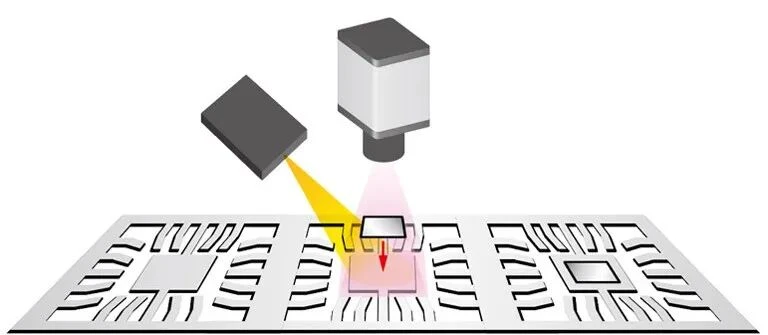
Die-attach (often referred to as die bonding, patch or die bonding in Chinese) is the first physical assembly process that is extremely critical in the semiconductor packaging process.
It literally means "attaching a bare chip to a substrate or lead frame". Before this step, the chip was just a small piece of silicon cut off from the wafer; After this step, the chip really "settles down" inside the package.
The three core purposes of die-attach:
Mechanical support: Securely fastens the fragile silicon chip to the substrate or lead frame, allowing it to withstand subsequent wiring pressures.
Heat Dissipation: Chips generate a lot of heat when they work, and the die-attach layer is the first physical bridge for heat transfer to the substrate and external heat sinks.
Electrical connections: For some power devices (such as MOSFETs or IGBTs), where the back of the chip itself is an electrode (usually a drain or collector) of the circuit, the die-attach material must have excellent conductivity and act directly as a current channel.
What is the standard operation of the die bonding machine?
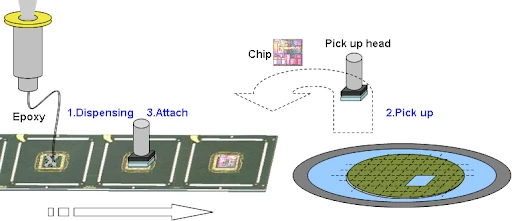
Taking the most common silver adhesive patch as an example, the high-speed operation of a fully automated die-attach machine (die bonder) usually consists of the following steps:
Dispense: The dispensing tip places a drop of silver glue precisely in the center of the lead frame (usually in the shape of a "meter" or snowflake to allow the glue to spread around).
Ejection: The wafer is attached to the blue film, and the ejector pin at the bottom gently ejects the target chip to free it from the stickiness of the blue film.
Pick: The vacuum nozzle (tip) above precisely sucks the chip surface and takes it away.
Placement: The robotic arm moves the chip above the substrate and presses the set pressure (Bond Force) and time on the glue just applied, ensuring that the glue evenly covers the bottom of the chip and there are no bubbles.
Send Inquiry