


What is a Wafer Map? What is its purpose?
Jul 02, 2026
Leave a message
In the semiconductor manufacturing field, a wafer is a silicon wafer used in the integrated circuit production process, serving as the carrier for chip manufacturing. After manufacturing, testing equipment tests and evaluates the function of each chip (or die) on the wafer. These test results are represented on the corresponding physical location on the wafer, resulting in a wafer map. Wafer maps transform key data from chip testing and manufacturing processes into intuitive and easy-to-understand graphics, providing decision support for the entire semiconductor manufacturing process. There are several
types of
wafer maps, the most basic being the bin map. Bin maps are commonly used tools in the wafer testing phase. By classifying and labeling the test results of each chip, they visually present the distribution of qualified and unqualified chips on the wafer. Qualified chips are usually marked as Bin1, indicating that they have passed all electrical tests; unqualified chips are marked as Bin2 and above, with different numbers corresponding to different failure causes, such as short circuits or leakage. Engineers can quickly locate concentrated failure areas and identify batch problems using color coding.
Parameter maps focus on displaying continuous test values on the wafer, using color gradients to show the continuous changes in chip electrical parameters and revealing the performance distribution patterns on the wafer surface. For example, when using a blue-yellow gradient to represent current distribution, engineers can directly observe spatial characteristics such as "higher current in one corner of the wafer and lower current in the center." These patterns often point to process problems such as lithography machine precision deviations and uneven thin film deposition.
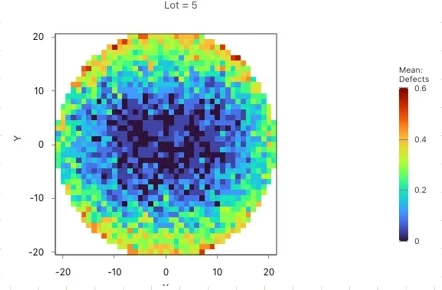
Defect maps focus on physical defects generated during wafer manufacturing, such as particle contamination, scratches, and pattern distortion, and are a core tool for tracking process stability. Defect maps can track defects by manufacturing process, pinpoint the specific stage where the problem occurs, and distinguish defect types by shape or color to help determine the root cause of the defect. A particularly useful analysis method is the "defect chip map," which overlays all chips to identify whether defects always appear in specific locations on the chip, thereby determining whether there are problems with specific functional modules.
In addition, overlaying and analyzing grading maps with defect maps is a key means of linking "physical defects" and "electrical test failures." The semiconductor manufacturing process takes approximately three months from start to finish, during which electrical testing cannot be performed, and only defect detection data can be obtained. Through overlay analysis, engineers can understand how effective detection methods are at capturing problems that ultimately lead to electrical failures.
A core application of wafer mapping
is providing crucial clues for tracing the causes of anomalies. Defect patterns arising during wafer manufacturing can be broadly categorized into global defects and local defects. Global defects are scattered across the entire wafer and are caused by random factors, such as particles in the production environment; local defect patterns are typically clusters of defects caused by traceable factors, such as human error, equipment contamination, and chemical pollution. Experienced engineers can determine the causes of defects based on these patterns. For example, scratch patterns may be caused by scratches during the production process, allowing for defect reduction by inspecting the production line and addressing related issues.
In practical applications, wafer mapping analysis can classify and track defects, establish trend libraries by defect type, correlate with equipment maintenance cycles, material batches, and other information, and identify hidden patterns. It can also perform hierarchical trend analysis, plotting defect quantity change curves for each manufacturing layer and pinpointing time points of process fluctuations. Furthermore, it can integrate data related to product type, wafer batch, production tools, and process modules to identify anomaly patterns under specific tool and process combinations. By setting key indicator thresholds, alarms are automatically triggered when data exceeds the thresholds, enabling early intervention of problems.

However, in actual production, manual analysis of wafer maps is tedious, time-consuming, and costly. The quality of analysis is limited by the skill level of engineers, making consistency difficult to guarantee. Furthermore, the spatial defect characteristics of wafer maps are constantly changing due to the combined effects of specific fault types, periods, and products, making analysis challenging. As production progresses, new faults cause defect patterns of unknown types that cannot be directly handled by existing models. Therefore, researchers both domestically and internationally are applying machine learning, statistical methods, and even deep learning techniques to the classification and analysis of wafer defect patterns, aiming to achieve efficient and automated wafer map analysis.
Against the backdrop of the semiconductor industry moving towards more advanced processes, wafer maps have evolved from simple data visualization tools into crucial support for yield improvement. Classification maps, parameter maps, defect maps, and their overlay analysis, by transforming complex data into spatial patterns, help manufacturers identify process deviations, equipment failures, and design defects at an early stage, ultimately achieving the goals of early detection, early adjustment, and high yield.
Send Inquiry