
Anodizing
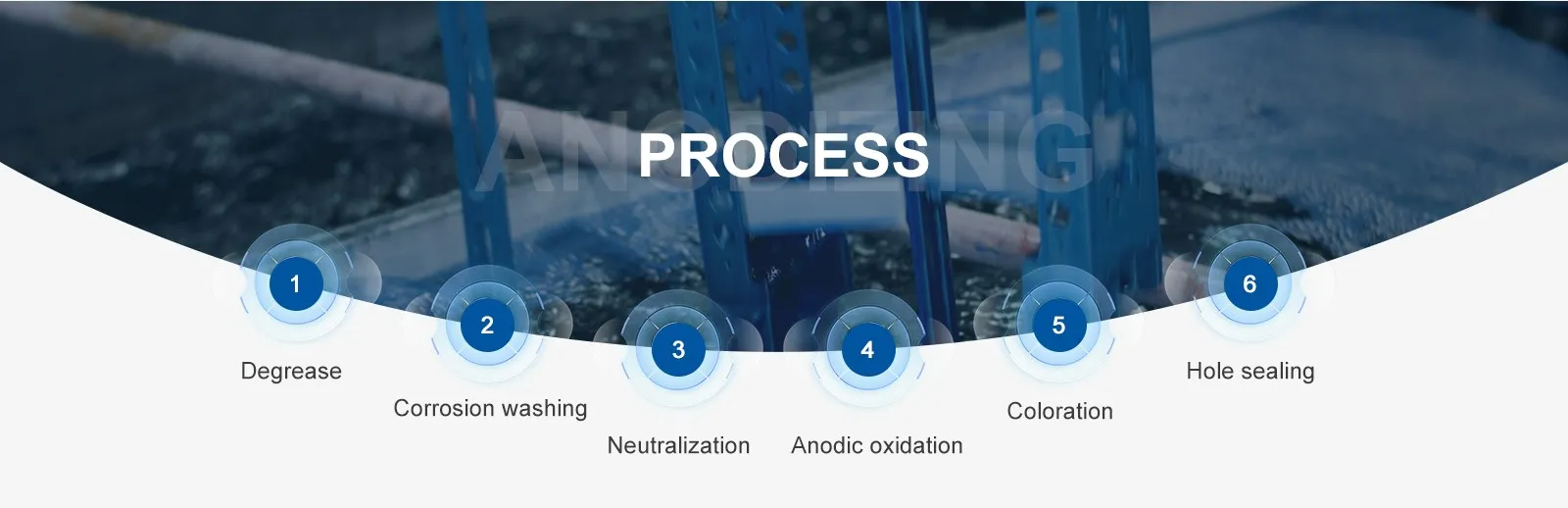
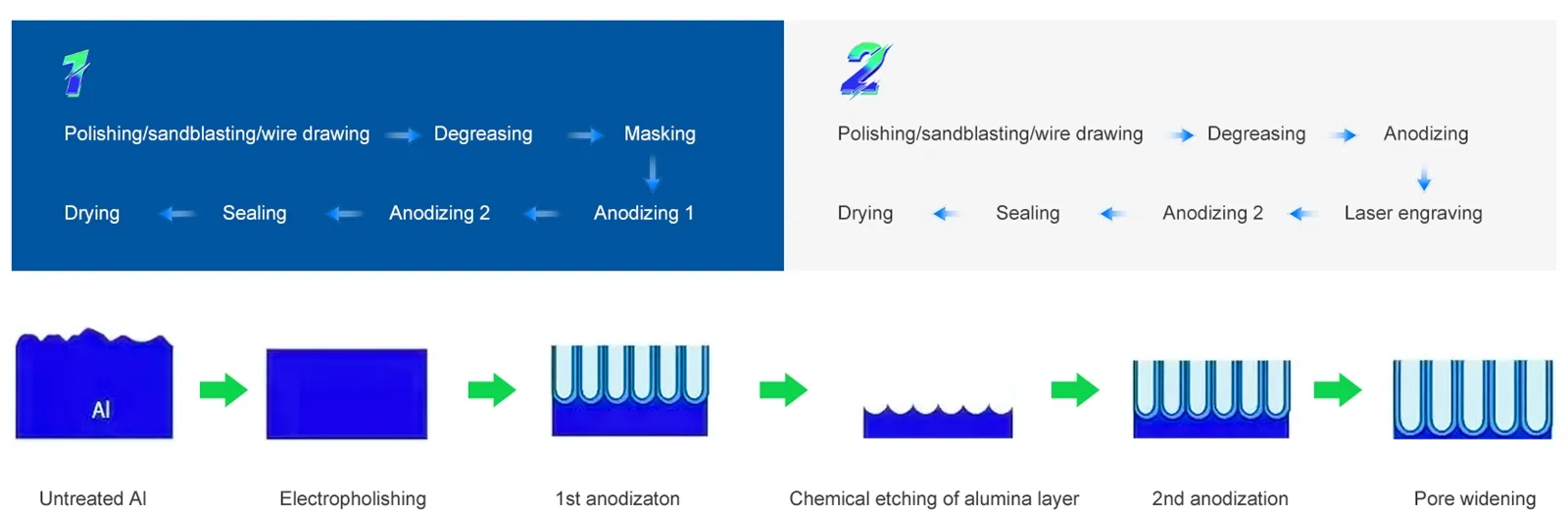
Mainly the anodizing of aluminum, it is the use of electrochemical principles to generate a layer of Al2O3 (alumina) film on the surface of aluminum and aluminum alloys. This oxide film has special characteristics such as protection, decoration, insulation, and wear resistance.
Monochrome, Gradient Color

Two-color
Electrophoresis
Electrophoresis is the electrophoretic coating at the cathode and anode, under the action of voltage, the charged paint ions move to the cathode, and the alkaline interaction with the cathode surface to form insoluble substances, which are deposited on the surface of the workpiece
Process

Blackening
The surface of steel parts is blackened, and some are called bluing. The principle is to rapidly oxidize the surface of steel products to form a dense oxide film protective layer and improve the anti-rust ability of steel parts.
Traditional alkaline heating blackening and late room temperature blackening. However, the effect of the room temperature blackening process is not very good for mild steel. A3 steel is better with alkaline blackening.
The ferric tetroxide oxidized at high temperature (about 550 ℃) is sky blue, so it is called blue. The ferric oxide formed at low temperature (about 3 50 ℃) is dark black, so it is called blackening.The oxide film formed by the "blue" treatment on the surface of the ferrous metal is mainly ferric oxide on the outer layer and ferrous oxide on the inner layer.
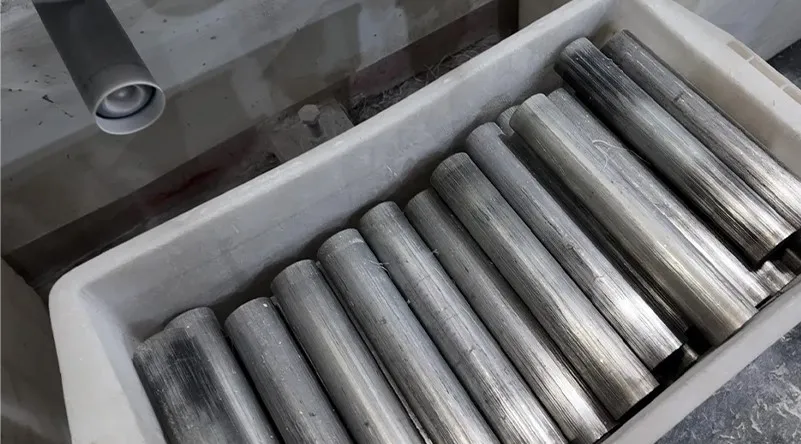
The operation process of bluing (blackening)

The so-called saponification is to soak the workpiece with a soapy aqueous solution at a certain temperature. The
aim is to form a thin film of iron stearate to improve the corrosion resistance of the workpiece.
The surface of steel parts is blackened, and some are called bluing. The principle is to rapidly oxidize the surface of steel products to form a dense oxide film protective layer and improve the anti-rust ability of steel parts.
Sandblasting is the use of compressed air as the power to form a high-speed jet beam to spray the sprayed material (copper ore, quartz sand, emery, iron sand, Hainan sand) to the surface of the workpiece that needs to be treated at high speed, so that the appearance or shape of the outer surface of the workpiece surface changes, due to the impact and cutting effect of the abrasive on the surface of the workpiece, the surface of the workpiece obtains a certain cleanliness and different roughness, so that the mechanical properties of the workpiece surface are improved, so the fatigue resistance of the workpiece is improved, and the adhesion between it and the coating is increased. It prolongs the durability of the coating film and is also conducive to the leveling and decoration of the coating.
The paint or powder is attached to the surface of the workpiece by pressure or electrostatic force, so that the workpiece has anti-corrosion and appearance decoration effects.
The substrate is primed and topcoated, and each time the paint is applied, it is sent to a dust-free and balanced temperature baking room for baking.
It is a microporous (fine-slit) permeation sealing process. The sealing medium (usually a low-viscosity liquid) is infiltrated into the micropores (fine cracks) through natural osmosis (i.e., microporous self-priming), vacuuming and pressurization, filling the gaps, and then solidifying the sealing medium in the gaps by natural (room temperature), cooling or heating to achieve the effect of sealing the gaps.
Modification of the surface of a workpiece using flexible polishing tools and abrasive particles or other polishing media. Polishing does not improve the dimensional accuracy or geometrical accuracy of the workpiece, but is intended to achieve a smooth surface or mirror gloss, and sometimes to remove gloss (matting). A polishing wheel is usually used as a polishing tool. The polishing wheel is generally made of multiple layers of canvas, felt or leather, clamped on both sides with metal round plates, and its rim is coated with a polishing agent made of a uniform mixture of micronized abrasives and greases. When polishing, the high-speed rotating polishing wheel (circumferential speed is more than 20 m/s) presses to the workpiece, so that the abrasive produces rolling and micro-cutting on the surface of the workpiece, so as to obtain a bright machined surface, and the surface roughness can generally reach Ra0.63~0.01 microns; When a non-grease matting polish is used, shiny surfaces can be matted to improve appearance.
Ultrasonic Cleaning
It is the direct and indirect effect of ultrasonic wave on liquids and dirt by using the cavitation, acceleration and direct flow of ultrasonic waves in the liquid, so that the dirt layer is dispersed, emulsified and peeled off to achieve the purpose of cleaning.