


Pitch walking introduction
Jul 02, 2026
Leave a message
Pitch walking (also known as pitch offset or pitch skew) refers to the phenomenon where the pitch between features (such as linewidth or spacing) changes unexpectedly during the patterning process of a semiconductor wafer.
Source: AMAT
In ideal semiconductor manufacturing, all nanowires and spacing should be arranged perfectly symmetrically and uniformly. Once pitch walking occurs, these lines or spacings become uneven, losing their original uniformity.
Pitch walking typically occurs in self-aligned multiple patterning techniques such as SADP and SAQP. When chip nodes shrink to 22 to 26 nanometers or smaller, exceeding the limits of traditional single-exposure lithography , fabs use multiple deposition and etching processes involving "mandrel + spacer" to double the line density.
In this complex process flow, small process fluctuations are amplified at each stage:
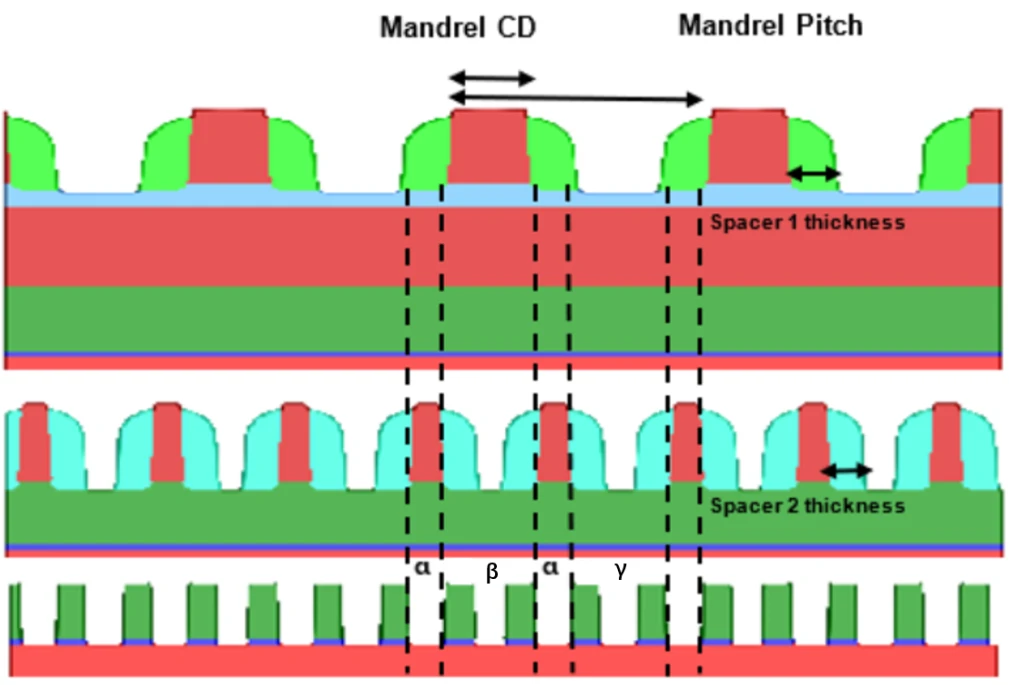
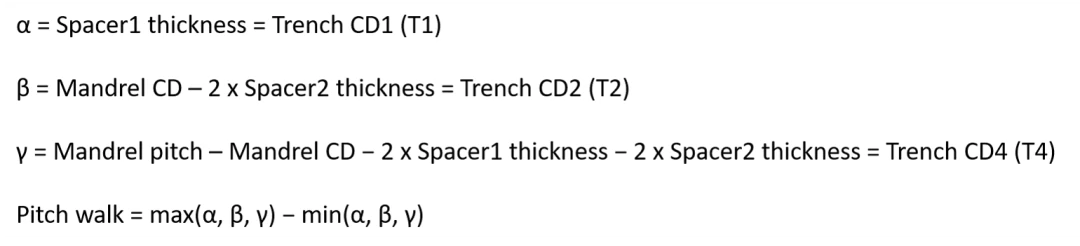
Inconsistent critical dimensions (Mandrel CD): Errors in the dimensions of the mold produced by initial photolithography or etching.
Deposition non-conformity: Due to uneven material deposition, the sidewall thickness varies.
Etch Behavior Variation: The removal rate varies in different areas during the etching process.
These minute inconsistencies caused by process variation, after being multiplied by multiple self-alignment processes, will eventually transform into alternating asymmetry in line spacing, resulting in Pitch Walking.
Influence
Pitch walking can have a serious impact on the overall performance and manufacturing yield of advanced chips:
Performance and power consumption degradation: Variations in pitch and linewidth directly degrade the performance of the chip's electronics, reduce power efficiency, and compromise signal integrity.
Line-Bridge Defects: When pitch walking and line-edge roughness (LER) from photolithography are superimposed, the process window shrinks drastically. This causes adjacent lines to move closer together or even touch, forming bridging defects (short circuits), leading to electrical failures and a collapse in yield.
The trench numbering scheme is shown in the figure below. Among them, even-numbered trenches are most prone to line bridges. This is because at these locations, the interaction between pitch walking and line edge roughness (LER) causes adjacent spacer walls to merge together, thus forming bridging defects.
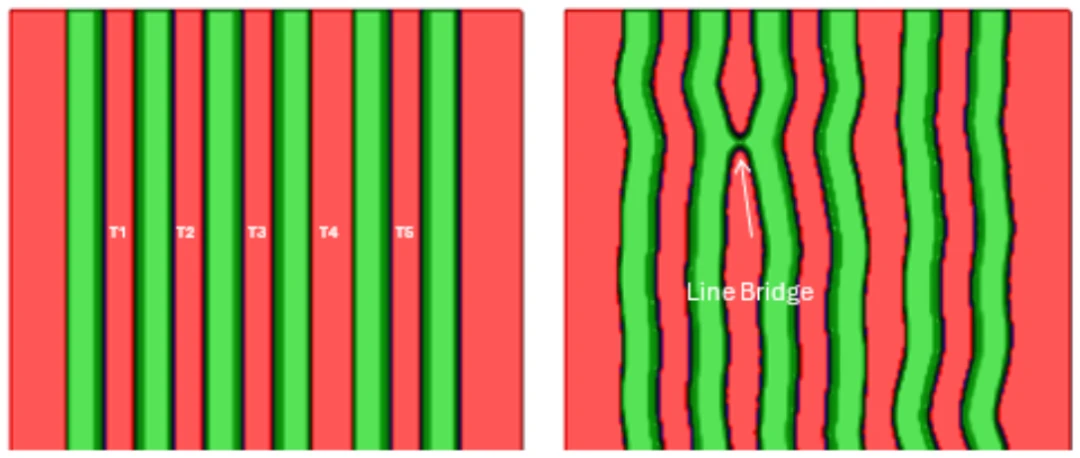
Trenches (SAQP final features) T1-T5 are considered for trench CD measurement to achieve α, β, and γ values.
0040-02544 Upper Body, Dps Metal
Reference:
1.Lam Research
2.AMAT-Pitch walking
3.5 NM FIN SAQP Process Development and Key Process Challenge Discussion
Send Inquiry