


【Semiconductor etching process】The soul of semiconductors teaches the etching process and the practice of engineers on defective rate problems from 0 to 1 (CH1-CH2)
Aug 19, 2025
Leave a message
Content
CH1. Transister/CMOS Vertical Structure
CH2. Definition and term of etching process
CH3. The purpose of the Etch process and the concept of plasma
CH4. Plasma Generation and Characteristics
CH5.Types and Applications of Plasma, Principle of DryEtch
CH6 Understanding and Requirements of Dry Etching Methods
CH7. Structure of dry etching equipment
CH8.Dry etching process
CH9.Wet etching process
CH10. Etching defect cases and etching engineer practice
CH1. Transister/CMOS Vertical Structure

The components of a MOS transistor are composed of four terminals: gate, source, drain, and Si_Sub.

P-sub = P-type (hole) low-concentration doped silicon substrate
Q-N+ / P+ = highly concentrated doped electrons or holes
N-/P- = low concentration doping
STI = PMOS vs. NMOS separation zone
PMD or ILD1 = Insulation layer before Metal1 / Insulation layer between the gate layer and the Metal1 layer
IMD = insulation between Metal1 and Metal2
USG = insulation without any impurity doping
ARC (Anti Reflection Coating) = Anti-Reflection Coating – Reflection suppression to prevent damage to the PR graphic during exposure, using SiON
W-CVD = Deposition of tungsten (W) by CVD
TiN-CVD = Deposition of Titanium Nitride (TiN) by CVD
CH2. Definition and terminology of etching process
Etching process: Definition = The process of local removal of thin films grown or deposited under the photoresist according to the purpose of the process after the PR development process.

Etch-related terms
Etch Skew = Wb(Lithography size = ADI CD)- Wa(Etched dimensions=ACI CD)
The difference between the mask CD and the ADI CD at design time is called Bias
ADI CD = After Development Inspection CD
ACI CD = After Clean Inspection CD
:Graphics formed by lithography change after going through the etching process → this must be considered when designing graphics!

Over etch and Undercut
Over etch= Etching is overdone and exceeds the desired thickness or depth → defects
Undercut= An unavoidable phenomenon in wet etching is that the etching area is larger than the open area

Etch rate (ER): The thickness of the target material to be removed during the etching time.

Selectivity (S) – An important parameter: the ratio of the difference in etch rate between different materials, or the ratio of the etch rate between the PR and the material

Etch uniformity – extremely important for etch engineers: the entire surface must be etched uniformly! Approximately 9 points are selected within and between wafers to measure the thickness before and after etching → Process repeatability is judged by standard deviation

Aspect Ratio = Height (h) / Width (w) → Large value indicates depth, and small value indicates width.
•Step Coverage
•Side coverage = s1/t, s2/t
•Bottom coverage = td/t
•=> value close to "1" is ideal.

Loading Effect
Micro loading effect
= For fine patterns, the discharge of reaction products after etching is not smooth, resulting in a better etching effect than wide patterns.
Occurs when the pattern is very fine or the etch is deep.
=> Solution: Use low pressure or speed up gas flow rate during the etching process!!

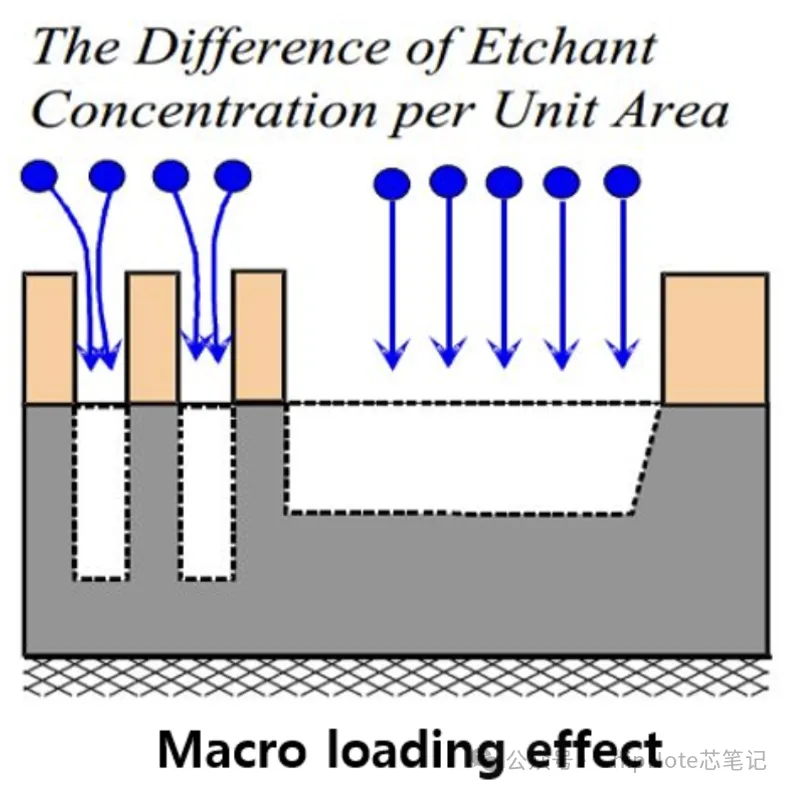
Macro loading effect
= Due to the large etching area, the supply of etchant is insufficient, resulting in poor etching in a wide area and the difference in etching depth.
=> Solution: Insert a dummy pattern over a wide area to make the pattern densely formed.
EPD(Endpoint detection)
Definition: A method used to determine whether the desired film layer has been removed in the etching process.
Classification: Optical Emission Spectroscopy (OES), using interference phenomena, monitoring the voltage and current of radio frequency (RF) waves.
Principle: Each atom has its own specific emission wavelength and presents different colors. When etching different materials, the color of the plasma changes,Optical sensors are used to detect this change and thus determine the end point of the etching process.
0040-79913 Cathode Liner,W/leak Check Port,300mm
Send Inquiry