


Principles of Photoresist Lithography
Feb 27, 2025
Leave a message
This article briefly introduces the various types of photoresist that can be photolithography and the principles that can be carried out.
TIN Chamber Assy
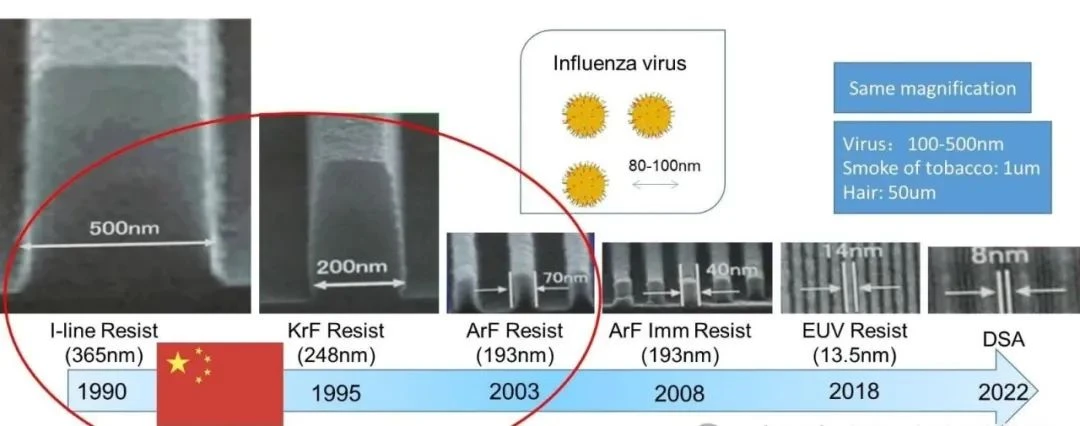
On the microscopic battlefield of chip manufacturing, photoresist is like a skilled "nano painter", using light brushstrokes to outline circuit patterns on silicon wafers that are thousands of times thinner than a hair. This amazing material is not only the core medium of the lithography process, but also the bridge between the design blueprint and the physical device. From the original micron transistors to today's 3nm process, the evolution of photoresists is almost equivalent to the history of the precision revolution in the semiconductor industry.
I,Photoresist
The essence of photoresist
Functions:
Pattern carrier: transfer the design pattern on the mask to the surface of the silicon wafer;
Protective barrier: Protects a specific area during an etching or ion implantation process;
Accuracy scale: directly determines the minimum machinable line width (i.e. resolution).
The thickness of photoresist on a 300 mm wafer is usually 50-200 nanometers, which is equivalent to evenly applying a layer of paint on a football field that is 1,000 times thinner than plastic wrap. The accuracy requirements are so demanding that it is even necessary to control the fluctuation of film thickness within ±1 nanometer.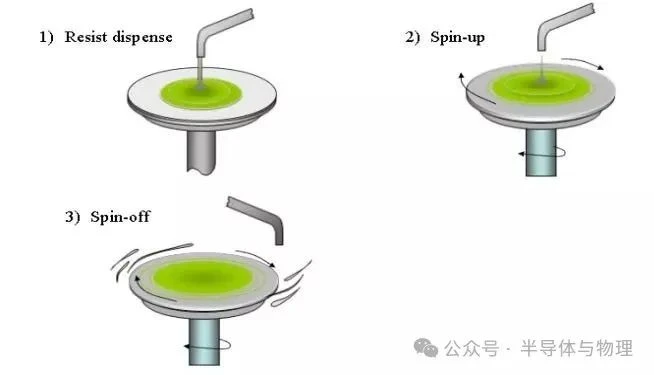
II,Composition of photoresist
Modern photoresists are made up of a variety of functional components, the composition of which includes::
|
Composition |
Functions |
Typical Substance |
|
Resin matrix |
It forms a colloidal skeleton that determines mechanical strength and etching resistance |
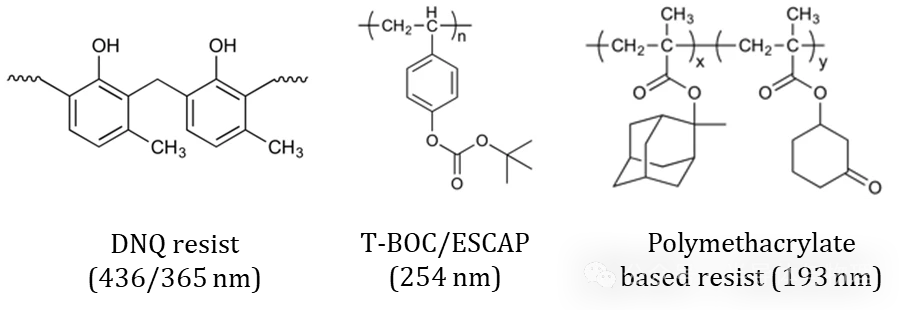
Phenolic resin (negative glue), polyhydroxystyrene (positive glue) |
|
Sensitizer |
Absorbing photons initiates a chemical reaction |
Diazonaphthoquinone, (DNQ),photoacid-producing agent(PAG) |
|
Solvent |
Adjust the viscosity to achieve uniform spin coating |
Propylene glycol methyl ether acetate(PGMEA) |
|
Additive |
Improves stability, surface wettability, etc |
Surfactants, stabilizers |
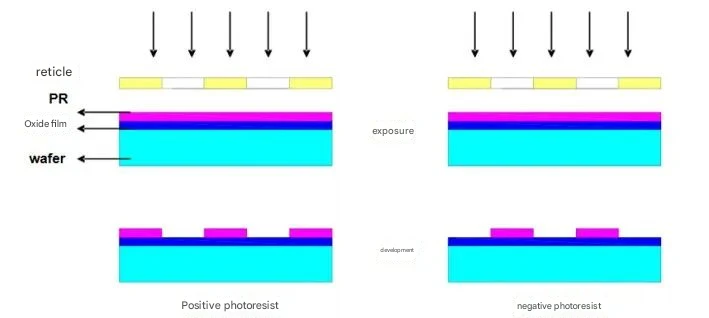
Positive vs. Negative:
(Positive Photoresist):· The exposed area undergoes a photodecomposition reaction and is dissolved during development, leaving a pattern of the unexposed area. Higher resolution, leading advanced processes.
(Negative Photoresist):· The exposed area is cross-linked and cured, and the exposure area is retained during development. The process is simple but the resolution is limited, and it is mostly used for coarse line processes such as packaging.

III,Exposure chemistry
When a specific wavelength of light (UV, deep UV or extreme UV) penetrates the mask and hits the photoresist, the "magic of light and shadow" at the molecular level is instantaneous:
Before exposure: Diazonaphthoquinone (DNQ) acts as a solubility inhibitor and binds tightly to the resin to make the colloid insoluble in the alkaline developer.
o Moment of exposure: DNQ absorbs photons (typically 365 nm i-line or 248 nm KrF lasers) and then decomposes to form indane carboxylic acid and release nitrogen:
o Development phase: The resulting carboxylic acids make the exposure area alkaline and soluble, which is precisely removed in a tetramethylammonium hydroxide (TMAH) solution to form the same pattern as the mask.
Negative glue
Exposure triggering: UV light activates photoinitiators (e.g., benzophenone) to produce active free radicals
Chain reaction: Free radicals attack the double bonds in the resin, triggering cross-linking between molecules to form a three-dimensional network structure:

Development contrast: the cross-linked area remains stable in the solvent, the unexposed part is dissolved, and the pattern is reversed to the mask.
Chemical Amplification Adhesive (CAR)
Single-photon triggering: An extreme ultraviolet (EUV, 13.5 nm) photon causes PAG (e.g., triphenylmatonium salt) to release H⁺:
Acid-catalyzed chain reaction: Acid diffusion in the post-baking (PEB) stage catalyzes resin deprotection reactions (e.g., removal of tert-butoxycarbonyl groups), triggering thousands of reactions per acid molecule, significantly increasing sensitivity:

Leap in resolution: This mechanism enables EUV gel to be exposed at a dose of 10mJ/cm², supporting the process below 7nm.
Send Inquiry