


How Intermediate Bonding Technology With Metal Is Realized?
Mar 04, 2025
Leave a message
0010-20351 6 INCH DEGAS LAMP MODULE 350C PVD
Bonding technology is mainly divided into direct bonding and bonding with an intermediate layer. Direct bonding such as silicon-silicon bonding, anode bonding and other bonding conditions are high, such as high temperature, high pressure, etc. Bonding with an intermediate layer, on the other hand, requires a lower temperature and less pressure. The mid-layer bonding technology with metal mainly includes eutectic bonding, solder bonding, hot press bonding and reaction bonding. This article mainly introduces eutectic bonding.
Eutectic bonding, also known as eutectic welding, refers to the bonding process in which two or more metal layers are directly converted from solid to liquid at a certain temperature, and the eutectic phase is formed on the bonding surface through the recrystallization of metals. The advantage of eutectic bonding is that the temperature of the bonding process is lower than that of direct bonding, and the melting point is much lower than that of monolayer metals; At the same time, the gas output during the bonding process is very low, and high vacuum zero-level packaging can be realized; In addition, since eutectic bonding is liquid-phase bonding, it is not sensitive to the flatness, scratches, and particles of the bonding surface, which is conducive to ensuring bond yield and mass production.
 Figure Schematic diagram of Al-Ge bonding
Commonly used eutectic bonding material systems include Au-Si,Au-Ge,Al-Ge,Au-Sn and Au-In. The bonding temperature of Au-Si and Au-Ge systems is about 400°C, that of Al-Ge systems is about 420°C, that of Au-Sn systems is about 300°C, and that of Au-Sn systems is about 180°C. In order to achieve high-vacuum packaging, MEMS gyroscopes mostly use eutectic bonding technology of Al-Ge and Au-Si. To achieve low-temperature bonding packaging, eutectic bonding of Au-In is used in optical MEMS devices such as MEMS micro mirrors and VCSELs.
0010-20317 8" LAMP MODULE
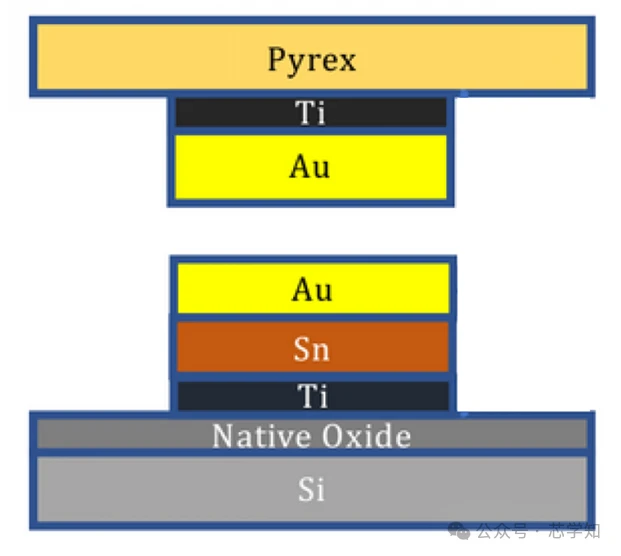
Figure Schematic diagram of AU-SN bonding
Eutectic bonding requires the creation of a metal layer on the bonding surface of two wafers, using methods such as sputtering and silk screen printing. Al-Ge bonding is patterned by magnetron sputtering on two bonding surfaces, and the bonding area is patterned by etching or peeling. Depending on the actual requirements and substrate conditions, it is decided whether to make UBM (Under Bump Metallization) with a thickness of 1 μm as an adhesion layer in advance. The thickness of the Al and Ge films is usually less than 1 μm, and after high temperature, the metals on the bonding interface form a mutual solution phase to form a eutectic structure and complete the bonding.
Au-Sn eutectic bonding usually uses the method of physical vapor deposition of the bonded surface of one wafer to prepare the laminated Au-Sn layer, and the bonding surface of the other piece of the bonded wafer is prepared by the method of physical vapor deposition, the thickness ratio of Au and Sn determines the composition of the intermetallic compound, and the characteristics of the intermetallic compound determine the quality of the bond. The commonly used thickness ratio is Au:Sn=8:2.

Figure Bonding the middle layer Au-Sn ratio
Send Inquiry