


PVD (Physical Vapor Deposition) Pretreatment Degas Process (How Much Do You Know About Those Hidden Knowledge Points?) )
Aug 12, 2025
Leave a message
PVD (Physical Vapor Deposition) Pretreatment Degas Process (How Much Do You Know About Those Hidden Knowledge Points?) )
Degas (degassing/baking) in the PVD (Physical Vapor Deposition) process is a critical pretreatment step whose main purpose is to remove volatile contaminants (e.g., water vapor) adsorbed on the surface of the wafer and its interior. This step is typically performed after the wafer is fed into the deposition chamber and before the deposition of the film officially begins.
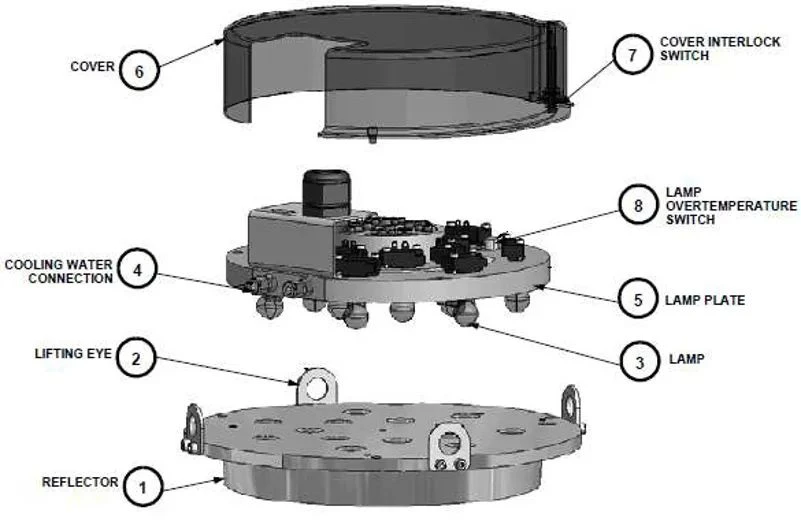
Figure1 DMD(Dual-Mode Degas) lamp
Structural diagram
Why is Degas so important?
1. Guaranteed film adhesion:
Water vapor, hydrocarbons, or other contaminants adsorbed on the surface of the wafer can form a weak boundary layer, which severely hinders the direct binding of deposited atoms/molecules to the substrate surface. Removing these gases is a prerequisite for obtaining good membrane-based bonding.
2. Improve film purity: Residual gases can be swept into the film during deposition and become impurities, affecting the film's chemical purity, electrical properties (such as resistivity), optical properties (such as absorption, refractive index), and mechanical properties (such as stress, hardness).
3. Improving film density and structure: Adsorbed gas molecules can interfere with the migration and diffusion of deposited particles, hindering their formation of dense, uniform grain structures, potentially leading to loose porous films or columnar crystals.
4. Maintaining Vacuum: The wafer is one of the largest gas sources in the deposition chamber. Without degassing, the wafer will continue to release gas when the chamber is pumped to a high vacuum, deteriorating the vacuum level of the chamber and making it difficult to achieve the high vacuum environment required for the PVD process (usually less than 10⁻⁶ mbar). This affects the deposition rate, particle energy, and film quality.
5. Ensure process stability: Insufficient outgassing will lead to inconsistent outgassing of wafers in different batches or even different positions in the same batch, resulting in fluctuations in film performance and thickness.
6. Prevent splashing and arcing: In PVD processes such as sputtering, if there is a large amount of water vapor or other ionizable gases on the surface of the wafer, it is easy to trigger unstable glow discharge, splashing or even destructive arc discharge at high power, damaging the target and wafer.
II. Degas Process
0020-70376 Degas Chamber
The core principle of Degas is to remove volatile contaminants on the surface by heating (baking) the wafer. Its main process is as follows:
1. Wafer placement: Load the cleaned wafer onto the Degas chamber of the PVD device;
2. The inert gas Ar is passed through to make the chamber reach a certain pressure, and the heating temperature of the lamp above the wafer is generally set at about 300°C (the base where the wafer is placed is maintained at 300°C throughout the process).
3. Heat and bake: Heat the substrate to a specific temperature and hold it for a while. This temperature and time are key parameters of the Degas process.
4. Evacuation: Start the vacuum pump set and pump the chamber to a base vacuum (e.g., 10^⁻8 torr or less).
5. After reaching the set pressure, remove the wafer and place it in the pre-clean chamber.
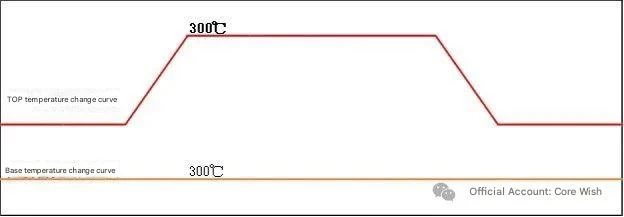
Fig.2 Temperature change curves of DMD BTM and TOP
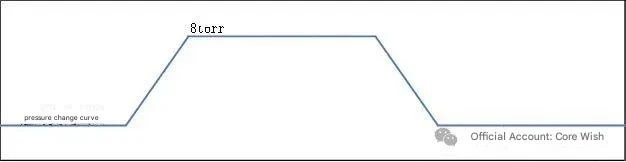
Fig.3 Curve of DMD chamber pressure
Key Process Parameters of Degas
1. Temperature: This is the most important parameter
Principle: The temperature must provide enough energy to break the physical adsorption (van der Waals force) and chemical adsorption bonds between gas molecules (especially water molecules) and the surface of the wafer, and even promote the diffusion and escape of dissolved gases on the superficial surface of the substrate. But the temperature should not be too high, too high will affect the metal layer of the front layer.
2. Time: Closely related to temperature
Principle: The time needs to be long enough to allow the heat to be fully conducted into the substrate (especially the thick substrate), so that the adsorbed gas has enough time to desorption and diffuse to the surface, and be pumped away by the vacuum pump.
3. Vacuum level
Base vacuum: Before starting heating, the chamber should achieve a sufficiently good base vacuum (e.g., < 10^⁻8 torr) to reduce background gas interference and improve heat conduction efficiency (heat convection is minimal at high vacuum, mainly by radiation and conduction).
0010-20351 6 INCH DEGAS LAMP MODULE 350C PVD
IV. Comparison of Degas vs Plasma Cleaning Pre-clean
Degas: It mainly solves the physical adsorption of gases (especially water vapor), and relies on thermal energy to remove the internal degassing effect of deep pores and complex structures, which is the main method of removing internal adsorbed gases.
Plasma cleaning (PCXT/RPC process): mainly solves the organic matter pollution and oxide layer on the surface, relying on chemically active particles and ion bombardment. It can effectively remove hydrocarbon pollutants and oxides.
Combination: In the PVD process, Degas is usually used first and then pre-clean is used in combination to achieve the best cleaning effect.
V. Conclusion
The Degas (Degassing/Baking) process in PVD pretreatment is a critical step in effectively removing volatile contaminants, mainly water vapor, adsorbed on the surface and inside of the wafer by heating it in a lower vacuum environment. Its core purpose is to improve the adhesion, purity, density and uniformity of the film, ensure the stable deposition process under high vacuum, and finally obtain high-performance and reliable film coatings. Precise control of Degas temperature, time and vacuum environment is key to process success.
Send Inquiry