


Introduction to Wafer Acceptance Test (WAT)
Dec 04, 2025
Leave a message
Behind high-tech products such as smartphones, computers, and autonomous vehicles lies a crucial semiconductor manufacturing technology – Wafer Acceptance Test (WAT). It is like a "full physical examination" of the chip, ensuring that each wafer meets stringent performance standards before leaving the factory. Whether you are an ordinary consumer or an industry practitioner, understanding the working principles and significance of WAT can help us gain a deeper understanding of the sophistication and complexity of semiconductor technology.

What is Wafer Acceptance Test (WAT)
1. Definition and core objectives of WAT
Wafer acceptance testing (WAT) is a critical quality control step in semiconductor manufacturing that evaluates the stability and consistency of the manufacturing process by measuring the electrical parameters of a specific test structure on a wafer. Its core objectives include verifying that process parameters meet design specifications, detecting possible defects in the manufacturing process, and providing data support for subsequent packaging and chip testing. WAT is usually performed after the completion of core processes such as lithography, etching, and thin film deposition, and is the last "quality checkpoint" before the wafer leaves the factory.

2. Special design of the test structure
WAT is not directly tested on the chip itself, but is achieved through a dedicated test structure distributed in the wafer scribe line or edge area. These structures include micro resistors, capacitors, transistor models, etc., capable of simulating the electrical characteristics of key components in chips. For example, measuring the resistance value of metal wires can indirectly reflect the accuracy of lithography and etching processes. The test results of the transistor threshold voltage are closely related to the ion implantation dose.

3. Difference between WAT and CP testing
Many people tend to confuse WAT with chip probing (CP). The difference between the two is that WAT is oriented to process parameter detection, uses a dedicated test structure, and is usually completed when the wafer is not cut; CP, on the other hand, directly tests the function and performance of each chip, and needs to touch the chip pads one by one. It can be said that WAT is the "barometer" of process quality, while CP is the "graduation test" of chip function.
What does WAT measure? Key parameter analysis
1. Contact resistors and interconnect resistors
The contact resistance of metals in contact with semiconductors is one of the core indicators of WAT. If the contact resistance is too high, it may lead to signal transmission delays or even circuit failure. Interconnect resistance reflects the conductivity of the metal wiring layer, and its numerical abnormalities may point to problems such as excessive etching or uneven metal deposition. Precise measurement methods such as four-point probe can accurately obtain the resistance characteristics of nanoscale structures.

2. Transistor performance parameters
The performance consistency of billions of transistors in modern chips directly determines product yield. WAT evaluates transistor manufacturing quality by testing parameters such as threshold voltage (Vth), saturation current (Idsat), and shutdown current (Ioff). For example, a threshold voltage shift may be caused by a deviation in the thickness of the gate oxide layer, while insufficient saturation current may suggest an abnormal doping concentration in the source-drain region.

3. Capacitance and voltage characteristics
Gate capacitance measurements verify the thickness and uniformity of the gate dielectric layer, which is critical for the switching speed of CMOS circuits. Breakdown voltage testing is used to evaluate the insulation properties of the dielectric layer, and abnormal values may indicate pinhole defects or contamination of the oxide layer.
How WAT is implemented
1. Development of test programs
Before WAT implementation, the test plan needs to be customized according to the process node and product type. Engineers need to determine the parameters to be tested and their tolerance ranges in combination with design rules, and write automated test scripts. For example, the 7nm process may require the addition of special test items for FinFET 3D structures, while memory chips need to focus on capacitance-related parameters.
2. Automated test system
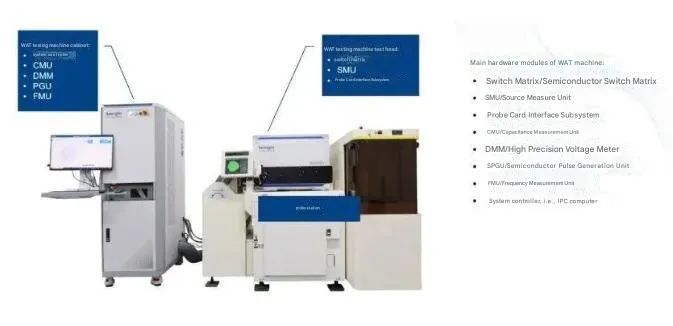
Modern WAT relies on clusters of precision instruments, including parametric analyzers such as Keysight B1500, probers, and temperature control systems. During testing, the wafer is vacuum-adsorbed on the stage, and the tiny probe of the probe card accurately touches the test structure, completing the data acquisition of thousands of measurement points in milliseconds. Some high-end devices also support multi-site parallel testing, greatly improving efficiency.
3. Data analysis and process feedback
The test data is analyzed in real time by statistical process control (SPC) software, and a wafer map is generated to visually display the parameter distribution. If the resistance value of a certain area is systematically high, it may indicate that the etching rate in this area is abnormal. Randomly distributed discrete anomalies may originate from particle pollution. This data is fed directly back to the process engineer to adjust equipment parameters or optimize process recipes.
Why WAT is indispensable
1. The economic value of quality control
A 12-inch wafer can make hundreds of high-end chips, and if the entire wafer is scrapped due to process defects, the loss can reach tens of thousands of dollars. WAT can detect anomalies at an early stage and prevent defective wafers from flowing into subsequent packaging processes. According to statistics, an effective WAT program can reduce the overall production cost by 15%-20%.
2. The cornerstone of technology iteration
0020-42287 PLATE PERF 8INCH EC WXZ
In the development of advanced processes such as 3nm and GAA transistors, WAT data provides key guidance for process development. By comparing the deviation of the experimental wafer to the target parameters, engineers can quickly locate problem links. For example, TSMC optimized the development process of EUV lithography through WAT data during the development of the 5nm process.
3. Components of industry standards
IMP Chamber ASSY
Standards such as SEMI E89 developed by the International Semiconductor Industry Association (SEMI) clearly stipulate the implementation specifications for WAT test items. Meeting these standards is not only a necessary condition for product launch, but also a reflection of the company's technical strength.
Send Inquiry