


How Should The Reverse Recovery Feature Of Diode Be Reflected In The Model?
Jan 09, 2025
Leave a message
0020-40946 CLAMP RING, 8" SNNF, AL
Half-bridge, full-bridge, and LLC power systems, as well as motor control systems' main power MOSFETs, freewheeling switches for synchronous buck converters, and secondary synchronous rectification switches, undergo a reverse current recovery process for parasitic diodes. The poor reverse recovery characteristics of the body diode of the power MOSFET lead lead to an increase in the switching loss of the diode, which reduces the efficiency of the system, and at the same time, it also generates high ringing, which affects the safe operation of the power MOSFET. How should the reverse recovery feature be considered in the model? Let's do some discussion on that today.
II.Diode direction recovery mechanism
When the body diode is externally applied with a forward voltage VF, the forward voltage weakens the internal electric field of the PN junction, the drift motion is weakened, the diffusion motion is enhanced, and the dynamic equilibrium of diffusion and drift is disrupted. As a result, holes (polysons) in the P region flow to the N region, and electrons (polysons) in the N region flow to the P region. The electrons that enter the P-zone and the holes that enter the N-zone become the few sons of the zone, respectively. Therefore, there are more fewer sons in the P and N regions than in the absence of applied voltage, and these extra few sons are called unbalanced few tons.

These non-equilibrium fewrons are diffusion in the N and P regions by the concentration difference during accumulation. Taking holes as an example, the hole concentration distribution is established in the N region, with the largest concentration near the edge of the junction and the smaller the farther away from the junction. The larger the forward current, the greater the number of holes stored and the greater the gradient of the concentration distribution. The diffusion of electrons into the P-region is similar, and the graph below shows the distribution of stored charges in the diode. The phenomenon of non-equilibrium minority carrier accumulation during forward conduction is often referred to as the charge storage effect.

When a reverse voltage is applied to the body diode, the electrons stored in the P region and the holes stored in the N region do not disappear immediately, but they are gradually reduced in two ways:
a. Under the action of the reverse electric field, the electrons in the P region are pulled back to the N region, and the holes in the N region are pulled back to the P region, forming a reverse drift current;

b. Recombination with most carriers. The reverse recovery process of the diode during the switching conversion process is essentially caused by the charge storage effect, and the reverse recovery time is the time required for the stored charge to disappear.
Double pulse test circuit
0200-09315 HChuck, ESC Cover Ring, Ceramic
Double-pulse test is a test method widely used in the characterization of power switching components such as MOSFETs and IGBTs. This test evaluates not only the switching characteristics of the target components, but also the reverse recovery characteristics of fast recovery diodes (FRDs) used in conjunction with body diodes and IGBTs. Therefore, it is very useful to evaluate circuits that cause losses due to reverse recovery characteristics during turn-on. The basic circuit diagram for the double pulse test is shown below.
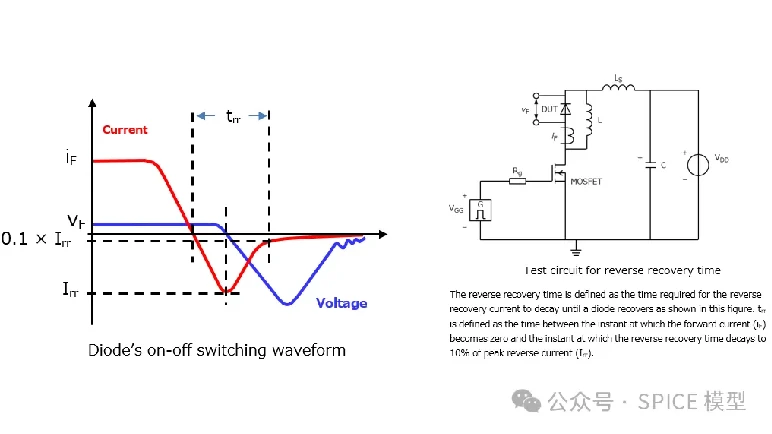
In this circuit, the upper side is the diode test tube, and the bottom side is the MOSFET for driving, and the basic work of double pulse test can be divided into three types: (1), (2), and (3). When the voltage of the pulser is defined as VPulse, the current flowing through the inductor is IL, and the voltage of the DUT is VDD. When the operation is in the (1) state, the MOSFET is in the ON state. The current path is: power supply→ inductance Ls→ inductance L→ MOSFET→ power supply. At this time, the inductor L accumulates. When the operation is in state (2), the MOSFET is turned off (I=0A), so the current path is: inductor L→ Diode forms a closed circuit and becomes freewheeling operation. When the operation is (3), the MOSFET is turned on (ON) again, and the current path is the power supply→ inductance Ls→ inductor L→ MOSFET → power supply, and the reverse recovery current of the diode overlaps with the on-on current, and the reverse recovery phenomenon can be seen by observing the current flowing through the diode.
How SPICE Model describes the reverse recovery feature
The total charge Q in a diode is made up of two parts: the charge accumulated in this region due to the change in voltage at both ends of the junction and the charge stored in the neutral region (NR), which is formed by a small number of carriers injected into the neutral region (NR). Junction capacitance CJ and diffusion capacitance CD are corresponding, respectively. Among them, the expression of CJ is as follows:

And the expression for CD is:
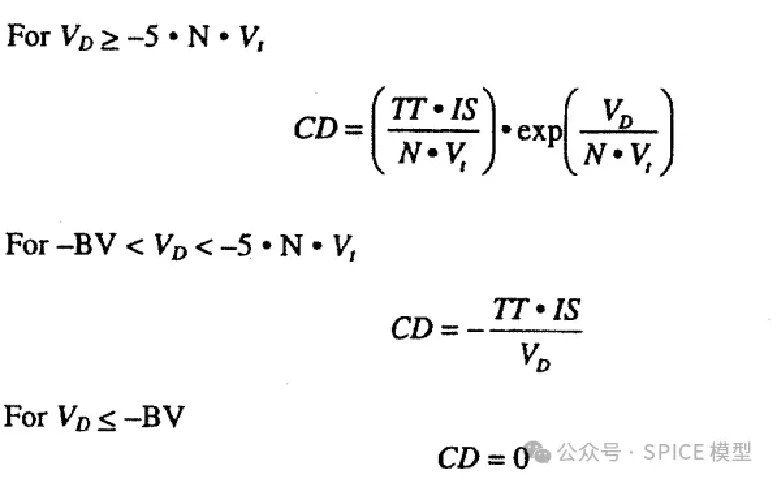
In other words, reverse recovery is related to the capacitance of the Diode. When we determine the capacitance parameters of CJ, CJO, M, FC, VJ. Then the parameter of reverse recovery is related to the parameter TT of CD.
How SPICE Model extracts the reverse recovery parameters
The extraction of Spice Model parameters can be done in ICCAP. ICCAP provides a basic diode example on which we can develop an example of reverse recovery parameter extraction verification.
In this example, a new DUT is defined, named Recovery, and a double-pulse test circuit is written, in this case, in spice syntax, which is the same as the corresponding emulator syntax.

Given the corresponding test simulation excitation, we can observe the characteristic curve of the reverse recovery by testing the current through the diode.

Tuning can be used in ICCAP to optimize the tuning of the corresponding parameters. When we Tuning TT parameters, we will see that the reverse current is changing.

Double-pulse test simulation verification
Similarly, we can set up a double-pulse test circuit in ADS.
The simulation results are as follows:
Summary
In practical applications, the body diode of MOSFETs brings us a lot of convenience and benefits, but we cannot ignore the impact of its reverse recovery characteristics on the system.
The magnitude of the trr value (which is related to the TT parameter in the model) directly affects the performance and reliability of the electronic device. Here are a few important factors that affect TRR on electronic devices:
Energy consumption and efficiency: A high TRR value means that the electronic device will take longer to recover in reverse, resulting in more energy loss. This reduces the energy efficiency and efficiency of electronic devices.
2. Switching speed: the smaller the TRR value, the faster the reverse recovery speed of the electronic device. In high-frequency switching applications, devices with short reverse recovery times can switch states more quickly, improving overall system responsiveness.
3. Reliability: When the current passes through the diode in the opposite direction, if the TRR value is too large, a higher reverse voltage peak will be generated. This can lead to power loss, heat generation, and device damage, affecting the reliability and lifetime of the entire circuit.
Send Inquiry