


Metal interlayer bonding
Jan 16, 2026
Leave a message
This article mainly talks about metal interlayer bonding.
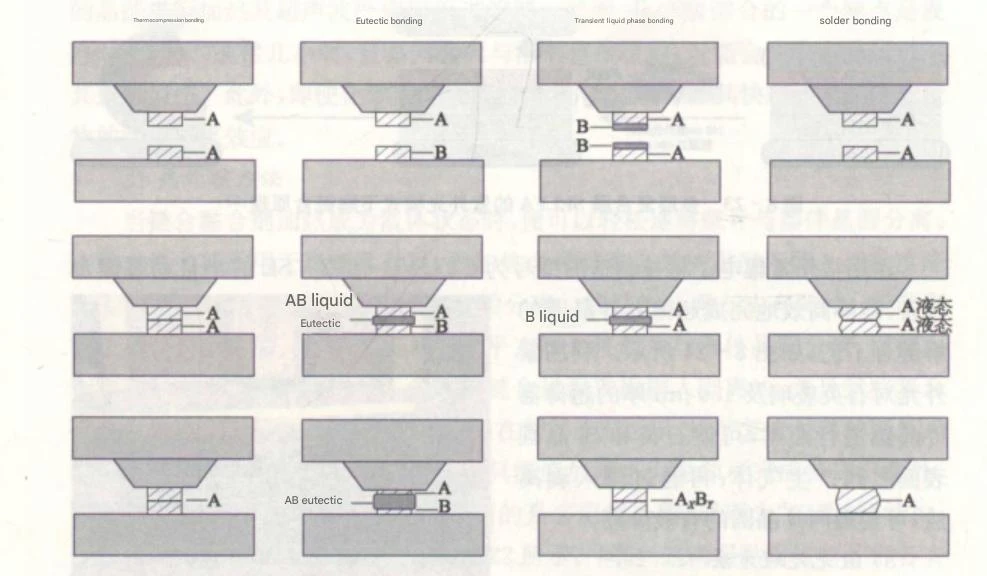
Metal interlayer bonding technology covers various types such as metal thermocompression bonding, metal eutectic bonding, solder bonding, and transient liquid phase (TLP) bonding. Figure 1 shows these four types and their corresponding bonding mechanisms. This article will focus on metal thermocompression bonding and metal eutectic bonding, which are widely used in the field of microelectromechanical systems (MEMS), especially in wafer-level vacuum packaging scenarios.
Metal thermocompression bonding
Metal thermocompression bonding is one of the core technologies in the field of microelectronic packaging, which uses a high-temperature and high-pressure environment to achieve tight bonding of the same metal material through solid-state diffusion, and the main application of bonding combinations includes gold-gold (Au-Au), copper-copper (Cu-Cu) and aluminum-aluminum (Al-Al). The core advantages of this type of bonding technology are low resistivity and excellent sealing properties, but it is constrained by the solid-state diffusion mechanism, which often requires higher temperatures and pressures, and has strict requirements for the flatness of the wafer surface. For the thermocompression bonding of Cu and Al materials, the temperature needs to be controlled above 400°C to ensure the bonding quality. In addition, the surface of Cu and Al is highly oxidizable, so it must be removed by a targeted oxide layer before bonding to ensure that the bonding effect is as expected. Compared with Cu and Al, Au-Au thermocompression bonding can be carried out at a lower temperature of about 300°C, and the Au surface is not easy to form an oxide layer, making the surface pretreatment process before bonding simpler. Au films have excellent ductility and can withstand a certain degree of deformation during the bonding process, making the Au-Au combination the optimal material choice for thermocompression bonding. However, due to the poor adhesion of Au on the surface of most materials, titanium (Ti) or germanium (Ge) is usually added as an adhesion layer when depositing Au films. At the same time, in order to prevent the diffusion of Au into silicon (Si) in high-temperature environments, a blocking layer with a thickness of about 20 nanometers, such as titanium nitride (TiN) or nickel (Ni), is also required.
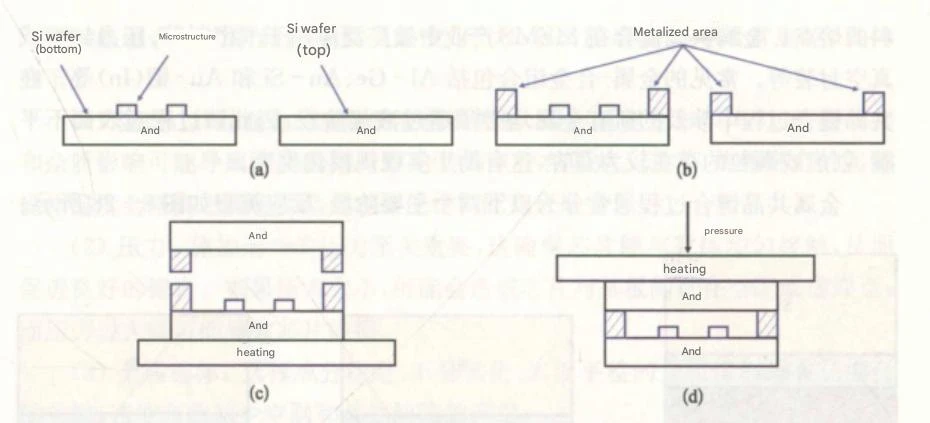
Taking Au-Au thermocompression bonding as an example, in order to achieve a stable and firm bonding of the structure and ensure the normal operation of the device, it is necessary to follow a standardized process flow (Figure 2), which includes the following key steps.
IMP Chamber ASSY
(1)Metallization pretreatment
The premise of high-quality bonding is that the surface of the Si wafer is kept highly clean and has a good interface condition, and usually uses an ethanol ultrasonic cleaning process to remove large particles of impurities and organic pollutants on the wafer surface.
(2)Surface metallization
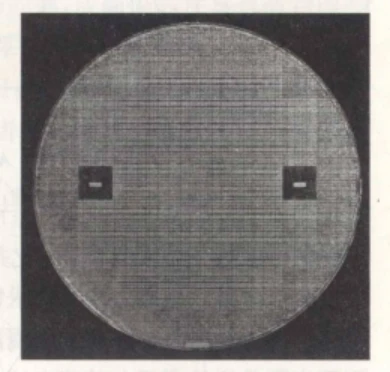
The core principle of Au-Au hot pressure bonding is that Au atoms are combined through diffusion and melting at specific temperatures and pressures, and the gold plating process mainly includes two common methods: sputter gold plating and evaporative gold plating. The surface roughness of the metal film formed by sputtering is low, while the surface roughness of the Au film formed by evaporative gold plating is high, so a thicker Au layer is required to ensure the bonding quality. Figure 3 shows the ultrasonic scanning results of Au-Au bonding after evaporative gold plating and EVG bonding equipment.
(3)Bonding pretreatment before hot pressing
Solid-state diffusion bonding is extremely sensitive to particle impurities and organic matter residues on the surface of Si wafers, and is usually soaked and cleaned with a mixed solution of sulfuric acid (H₂SO₄) and hydrogen peroxide (H₂O₂) to remove contaminants such as sweat and photoresist residues generated during processing. In addition, plasma activation processing can be used to improve the chemical activity of the wafer surface and enhance the bonding force during the bonding process.
(4)Thermocompression bonding
Temperature and pressure are the core factors affecting the quality of Au-Au bonds. Higher temperatures can soften Au films, enhance atomic diffusion, and improve bonding quality. At the same time, a reasonable increase in the bonding pressure can ensure full contact between the Au films and provide a guarantee for good bonding.
Metal eutectic bonding
Metal eutectic bonding refers to the phase transition process in which two or more metal combinations directly change from solid to liquid under specific conditions, which does not go through the solid-liquid mixing stage, and its eutectic temperature is usually lower than the melting point of each metal participating in the combination. This bonding technology is widely used in the MEMS industry in gas-sealing, pressure-packaging, and vacuum packaging, and common metal-alloy combinations include aluminum-germanium (Al-Ge), gold-silicon (Au-Si), and gold-indium (Au-In). Since all participating metals in the eutectic bonding process will go through the liquid phase stage, the tolerance for surface unevenness, scratches and particle impurities is high, which is conducive to large-scale mass production.
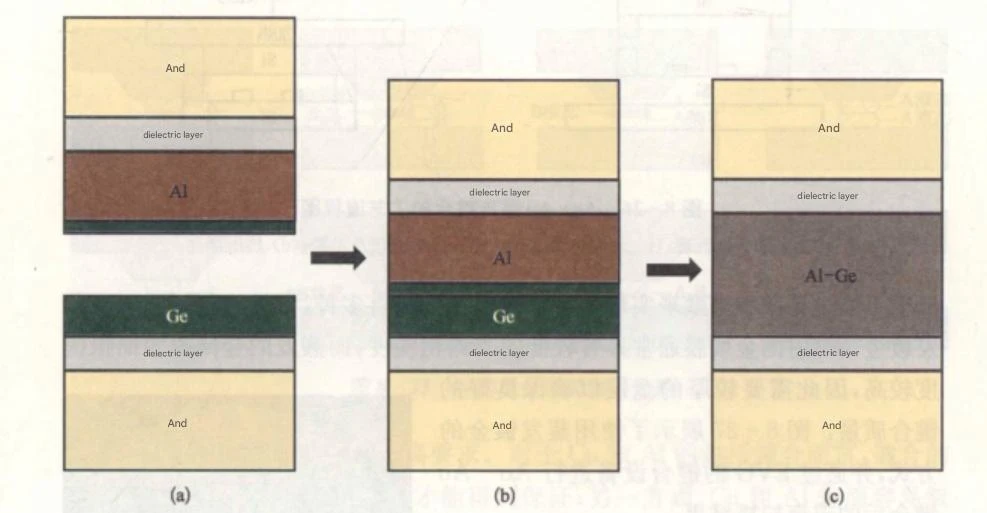
The metal eutectic bonding process is usually divided into two core stages, and the reaction flow is shown in Figure 4.
Phase 1
Metals with low melting points melt first to form a liquid phase, and then rapidly diffuse with metals with high melting points. Because the intermetallic compound seed crystals formed on the surface of metals with high melting points have high formation energy, they will accelerate the formation of intermetallic compounds. With the continuous consumption of high-melting point metals and the replenishment of low-melting point metals, the chemical reaction continues, and the intermetallic compound region continues to expand until the high-melting point metal layers are fully joined, blocking the further diffusion of liquid-phase metals.
Stage 2
Intermetallic compounds grow through high-melting point metals, a process that is slower and usually takes longer to completely deplete low-melting point metals. As the concentration of metals with high melting points changes, the melting point of intermetallic compounds gradually increases, and when the temperature is higher than the bonding temperature, the intermetallic compound begins to solidify. During continuous heating, the solid metal phase gradually changes to a more stable intermetallic compound structure. It should be noted that the thickness ratio of high and low melting point metals needs to be accurately controlled to avoid premature depletion of high melting point metals, resulting in a decrease in the bond strength of intermetallic compounds and Si wafers.
The quality of eutectic bonding is affected by multiple factors such as temperature, pressure, and metal layer selection, as follows:
(1)temperature
Eutectic bonding requires precise temperature control, and uneven temperature distribution, measurement errors, and impurity doping may lead to deviations between the actual temperature and the theoretical eutectic point. In practice, the bonding temperature is usually set slightly above the theoretical eutectic point to ensure that the material is fully fused.
(2)stress
Applying reasonable pressure is key to ensuring bond quality, ensuring uniform contact between the chip and the carrier, and facilitating the full bonding reaction. Too little pressure can easily lead to voids or virtual solder joints between the chip and the substrate, and too much pressure may cause chip damage.
(3)Metal selection
The selection of metal solder with stable composition, non-oxidation and flat surface can effectively reduce the occurrence of voids and other defects, which is the core prerequisite for achieving high-quality eutectic bonding.
(4)Cleanliness
Before bonding operation, it is necessary to ensure the cleanliness of the solder lug and the surface to be bonded, as any dirt, oil or residual impurities will affect the bonding quality of the bonding interface.
(5)Oxidation
The surface oxide layer reduces the wettability of the bonded material, resulting in a decrease in bond strength, so it is essential to perform adequate surface treatment to remove the oxide layer before bonding.
(6)thermal stress
To minimize the adverse effects of thermal stress, it is necessary to ensure that the chip has the appropriate thickness and that the coefficient of thermal expansion of the carrier matches or is close to the chip's coefficient.
Eutectic bonding is a complex and high-precision process whose core goal is to ensure that the upper and lower layers of wafers are precisely aligned and fixed within the bonding equipment, and finally sealed connections are achieved through heat and pressure. Taking aluminum-silicon (Al-Si) eutectic bonding as an example, the entire process can be broken down into four key steps:
(1)Gas displacement
The sealed chamber of the bonding equipment is replaced with gas, the oxygen (O₂) in the chamber is removed, and it is filled with gases such as nitrogen (N₂) that are chemically stable and do not react with the process material, creating a suitable bonding environment and avoiding unnecessary chemical reactions between O₂ and the material.
(2)Preheat
The upper and lower platens in the chamber are quickly heated by the heating device, and after the temperature reaches the preset value, the temperature is maintained to let the wafer rest for 30 to 45 minutes, fully releasing the residual gas inside the wafer and reducing the potential impact on the final performance of the device.
(3)Eutectic bonding
The gasket between the wafers is removed to make the upper and lower wafers fit tightly, and then slowly heat up to the eutectic point temperature and apply appropriate pressure to promote eutectic reactions between wafers to form a stable bonding structure.
(4)Cooling and decompression
After the eutectic reaction is completed, the wafer temperature is lowered through a cooling system, gradually removing the applied pressure. When the temperature drops to a safe range, the chamber is opened to remove the bonded wafer assembly.
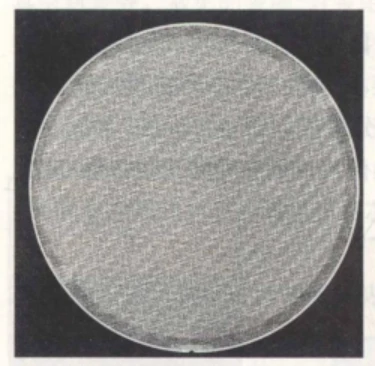
In actual bonding operations, many details need to be properly handled to ensure the bonding effect, such as controlling the cleanliness of the wafer before bonding, preventing oxidation of the Al layer on the wafer surface, and avoiding the overflow of eutectics during the Al-Ge eutectic process to affect the device function, etc., which are all technical challenges that need to be overcome in the semiconductor manufacturing process. Figure 5 shows the ultrasound scan image of Al-Ge eutectic bonding using a fully automated EVG bonding device.
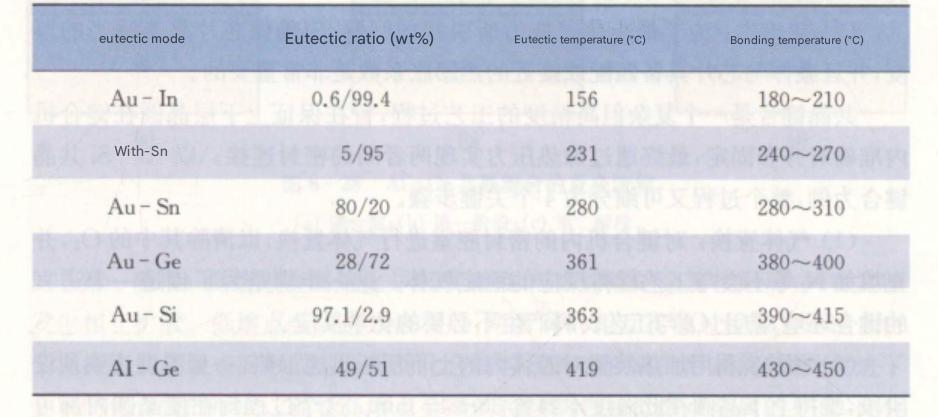
In addition to Al-Ge, Au-Si and Au-In combinations, the commonly used metal combinations for eutectic bonding also include Al-Si, Au-Ge, Au-tin (Sn), indium-tin (In-Sn), lead (Pb)-Sn, etc., and the bonding temperature requirements of different metal combinations are different. Due to the uneven temperature distribution and impurities, the actual eutectic bonding temperature is usually slightly higher than the theoretical eutectic point. Table 1 lists some common eutectic bonding combinations and their corresponding bonding temperatures.
END
Send Inquiry