


Samsung Is Heavily Invested Against SK Hynix And TSMC
Aug 19, 2024
Leave a message
0020-24914 COVER RING SST 8INCH 101 COVERAGE
0020-28346 8"CLAMP RING
The market for high-bandwidth memory (HBM), which is required for artificial intelligence (AI) computing, is rapidly expanding. Korea's SK hynix is leading the way and has been in short supply. SK hynix will cooperate with Taiwan Semiconductor Manufacturing Company (TSMC) to hold its position in the field of next-generation products, which are expected to increase transmission speeds by 40%. Korea's Samsung Electronics, which is backward in development, has used capital as a weapon to try counterattack
At the earnings conference on July 25, Kim Woo-hyun, chief financial officer (CFO) of SK hynix, said, "The development of AI semiconductors is accelerating. This is a favorable environment for us as industry leaders."
SK announced sales of 16 trillion won in the second quarter of 2024 (April~June) on the same day, 2.3 times that of the same period last year. The final profit and loss was a profit of 4 trillion won (compared to a loss of 2 trillion won in the same period last year), which was the highest in six years as sales in the second quarter. SK's HBM orders are scheduled until 2025.
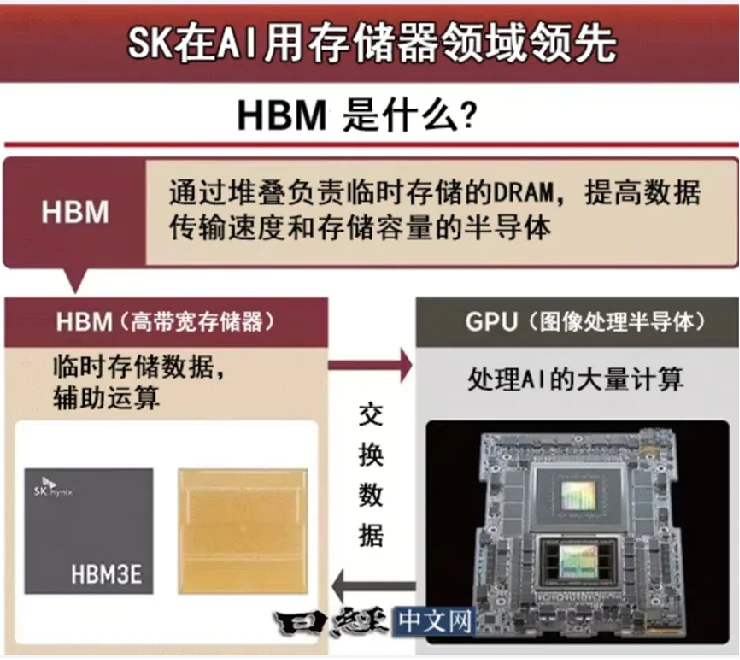
HBM is a type of memory that increases storage capacity and data transfer speed by stacking DRAM to temporarily store data. It acts as a secondary role to image processing semiconductors (GPUs) used in AI computing and is responsible for documenting the computational process. The faster the data exchange between the GPU and HBM, the higher the performance of the AI.
SK's state-of-the-art product, HBM3E, has a data transmission speed of 8Gbps per input and output terminal (number of pins). It is said to be able to process more than 230 Full HD movies per second.
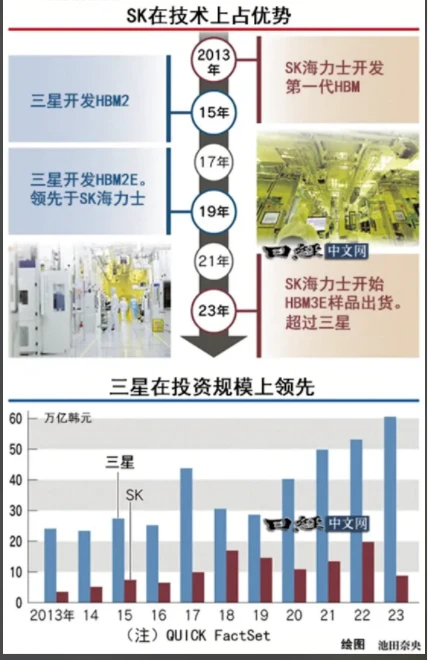
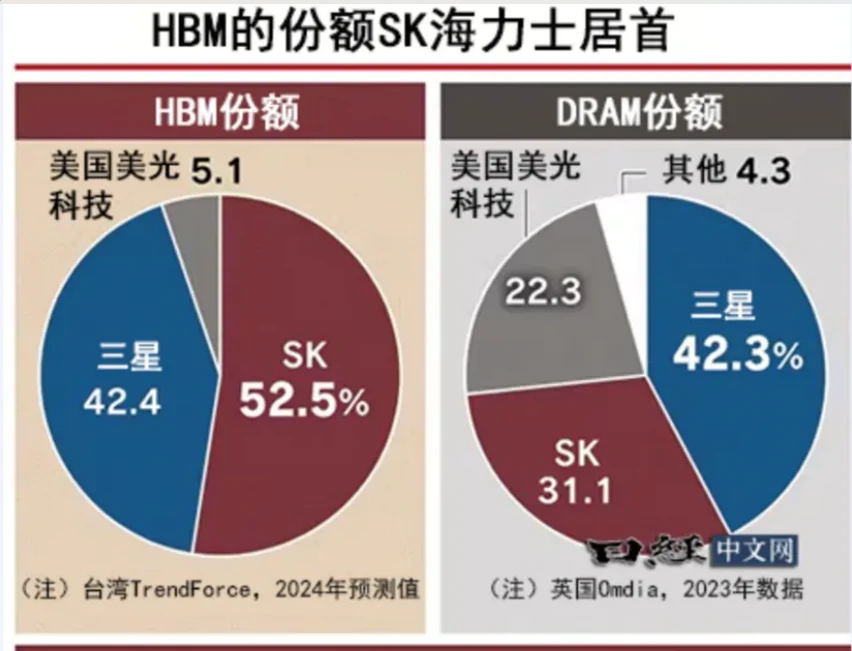
Samsung is the world's largest memory manufacturer, accounting for 42.3% of the global market share in theThe competition for HBM's development revolves around these two companies. SK was the first to develop HBM in 2013, and Samsung started full-scale development in 2015. Around 2020, Samsung was ahead of the curve, but with the development of SK's cutting-edge product "HBM3E" in August 2023, SK has achieved a comeback and further widened the gap.
Samsung is accused of being "overly obsessed with the miniaturization of semiconductors" (United States Semiconductor Trading Company). The performance of semiconductors improves with the reduction of the wire width. Samsung continues to pursue miniaturization with its strong financial strength, but the wire width of its cutting-edge products has reached the 10nm level, making it more difficult to develop technology.
SK, on the other hand, has found its way out of the stacked DRAM approach. The company has also pioneered relationships with material manufacturers. SK has jointly developed packaging materials that are indispensable for the production of cutting-edge products with Japan's NAMICS (located in Niigata City) and other companies, and has signed an exclusive supply contract.
SK is currently working with TSMC to develop next-generation HBM products, with the goal of starting mass production in 2025. It is said that the transmission speed of the new generation of products will be increased by 4%. TSMC is engaged in OEM production for United States Nvidia, which accounts for 90% of the GPU market. SK has indirectly strengthened its relationship with NVIDIA through its partnership with TSMC.
Samsung is lagging behind in obtaining Nvidia's latest AI semiconductor certification. Shawn Kim of Morgan Stanley in the United States pointed out that "Samsung is at risk of losing market share". Goldman Sachs' Giuni Lee predicts that "in the next 2~3 years, SK will maintain a market share of more than 50% in the field of cutting-edge HBM products."
In order to salvage the situation, Samsung replaced the head of the semiconductor division. The company broke with the practice of announcing executive personnel arrangements at the end of the year and announced personnel appointments ahead of schedule in May 2024. Trying to strengthen internal unity through unusual personnel arrangements, Samsung is also actively building relationships with Japan material manufacturers.
HBM's modernization is fast. Generally speaking, with each new generation of products, the transmission speed will be increased to about 1.5~2 times. So, if you can launch cutting-edge products before your competitors, you can make a profit before other companies catch up. Product renewal is a good opportunity to turn the tide of power.
Precision-stacked microsemiconductors are becoming more and more technically difficult, and production equipment is becoming more and more expensive. SK will invest KRW 103 trillion in equipment over the five years to the end of 2028, of which 80% will be used for HBM's technology development and mass production.
Samsung is also increasing HBM's share of total investment. In 2024, the supply of HBM will quadruple from the previous year and further by 2025.
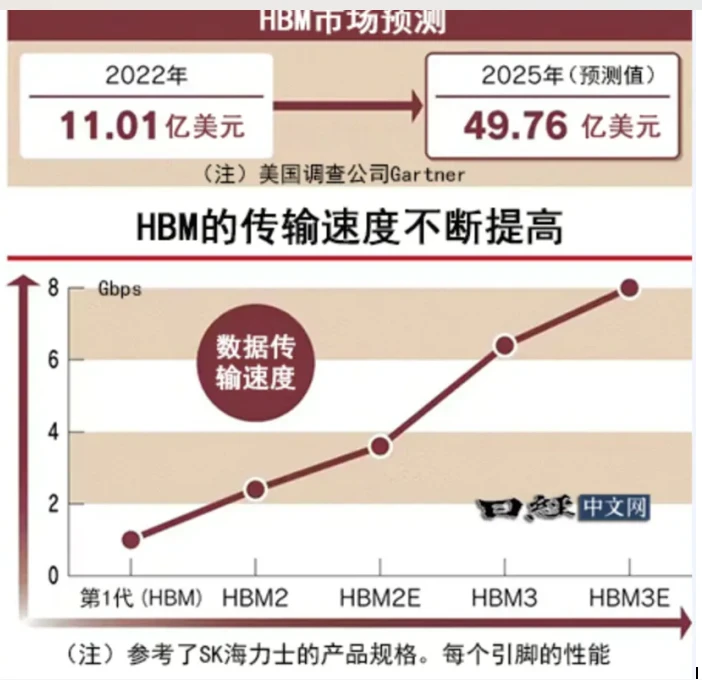
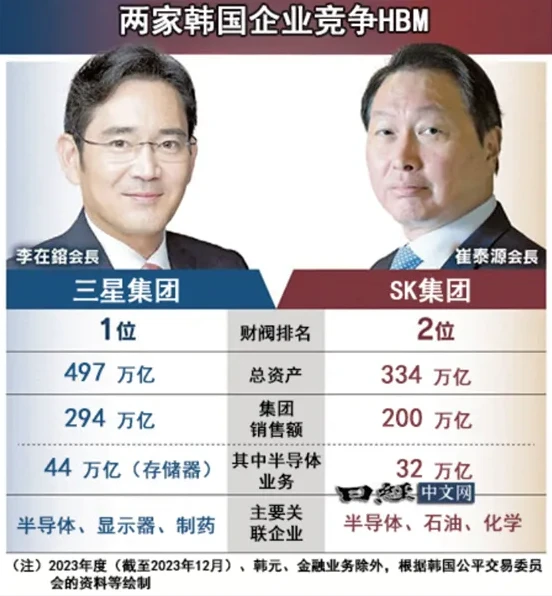
Noo Imonaka of the Rakuten Securities Economic Research Institute said, "From the second half of 2024, investment competition will begin in earnest." Samsung's total assets are 497 trillion won, 1.5 times that of SK. There is a view that Samsung has strong financial strength, and if the funds are used in investment competition, Samsung will be expected to win.
HBM is believed to have started to develop products for the next 2~3 generations. Micron Technology in United States is also looking for opportunities to join the competition. Can SK hynix stay ahead of the curve? Will Samsung be able to catch up with massive investment? The competition centered on the two Korea companies will continue.
Send Inquiry